Northward across the Mediterranean
pointed the Allied path toward victory.
Modern three-dimensional war was giving
the lie to ancient history’s lessons
against Mediterranean northbound invasion.
Precept had not reckoned with air power.
The Ninth Air Force moved into the island-conquering,
pre-invasion phase without rest from Tunisia.
Coordinating with the North African air,
land and sea forces, the Ninth shared
heavily in the actions that brought the
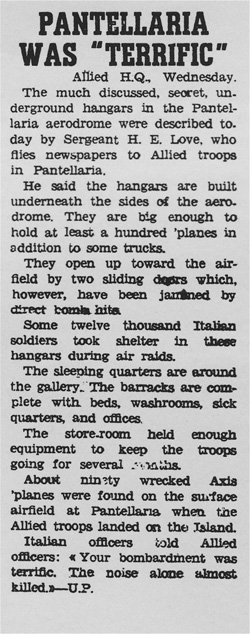
fall of Pantelleria the impregnable, and
in rapid succession, Lampedusa and Linosa.
The Fifty-Seventh was ordered
to prepare for the impending invasion
of Europe, with Sicily as the first stepping-stone,
and “A” party moved to Bou
Grara, L.G., Tunisia to waterproof vehicles
and equipment for an amphibious landing
operation. Meanwhile “B” party
operated from Cape Bon, bombing Pantelleria
and Lampedusa, and assisting greatly in
the surrender of their garrisons. Cape
Bon was a “scroungers paradise”
as the evacuating enemy forces left equipment
everywhere. Every fifty feet along the
road lay a German truck, jeep or trailer,
and the men in the Group soon were riding
around in eight-cylinder reconnaissance
cars and Renault convertible coupes. German
generators hummed in the camp nightly,
supplying power for lights and music furnished
by Herr Rommel’s radios. It was
amusing to tune a German radio to the
German propaganda station in Berlin and
hear Sally-talk about the “Butchers
of the Fifty-Seventh.” Later in
the month the two parties met at Causeway,
Tunisia, and after a few short days “A”
party moved to a rocky camp on Malta,
“the Gem of the Mediterranean.”
There the men saw the sights, watched
the tremendous quantities of invasion
material pile up, slept on the ground
under pup tents, and awaited D Day.
Fighters of the Ninth during
May flew 2,182 sorties on 162 missions.
This was during a period when many American
fighter pilots with hundreds of operational
hours accumulated in the long desert drive
were being returned to America to teach
or to head new units being trained for
war.
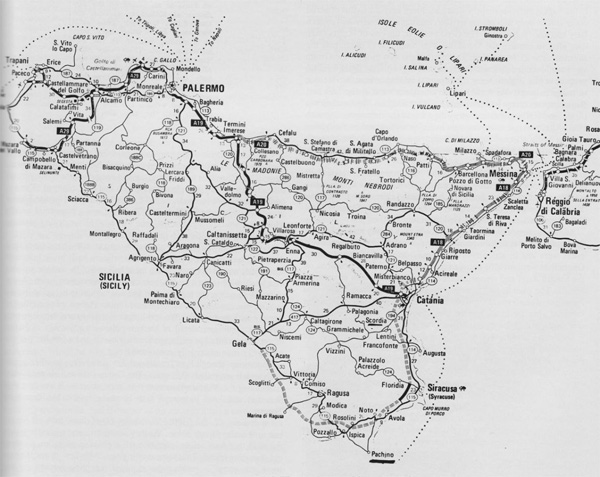
The Eighth Army invaded
Sicily on July 10 and nine days later
“A” party landed at Pachino,
Sicily, driving through the surf onto
the beach in typical newsreel style. Soon
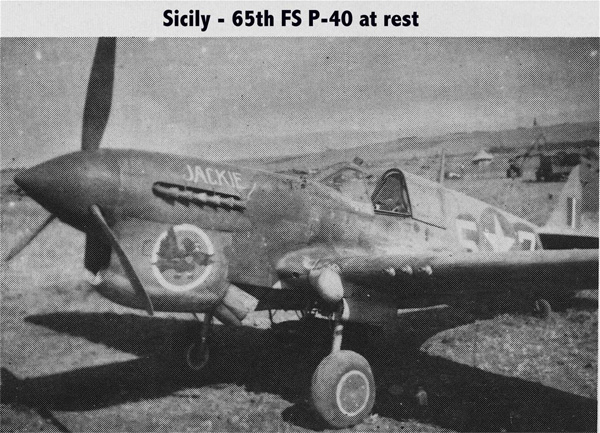
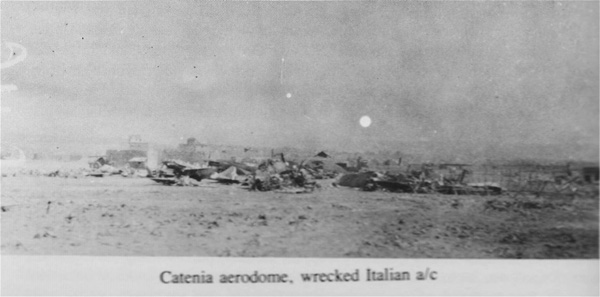
the entire unit was flying from one of
the Gerbini airstrips south of Catania,
hitting enemy movement in the northern
end of the island. The airfield was close
to the fierce battle-taking place on the
plains of Catania and the Group sweat
out several night attacks of the Luftwaffe,
luckily escaping one, which destroyed
many men and airplanes on an adjacent
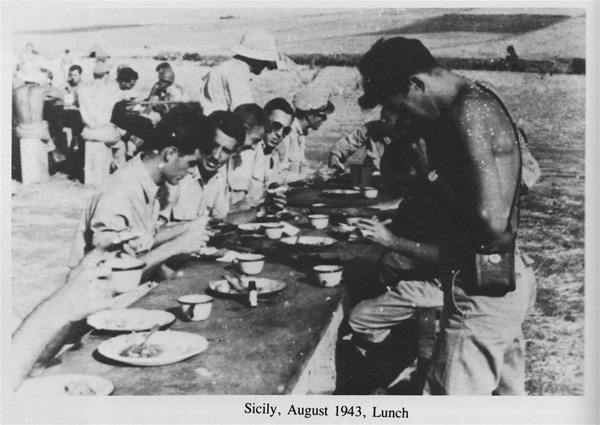
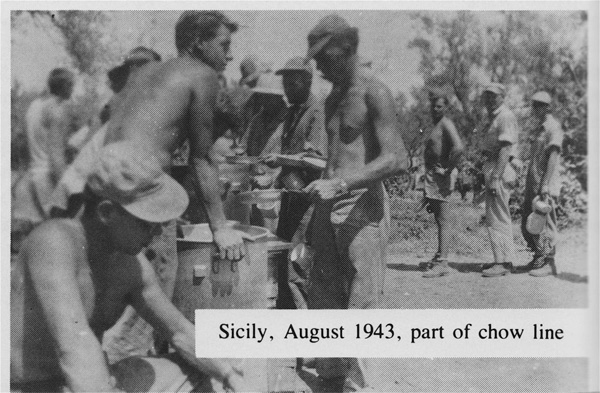
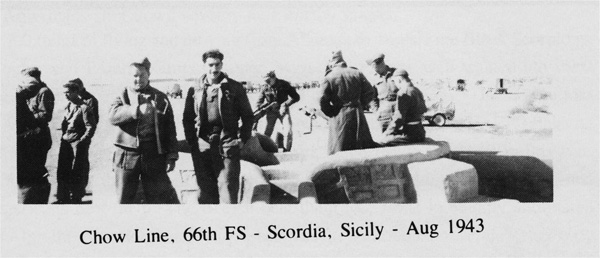
British field. The unit lived in an orange
grove and for the first time had fresh
vegetables with meals. Wine was plentiful
there at Scordia and a huge barrel was
on tap outside of the mens’ day
room every evening.
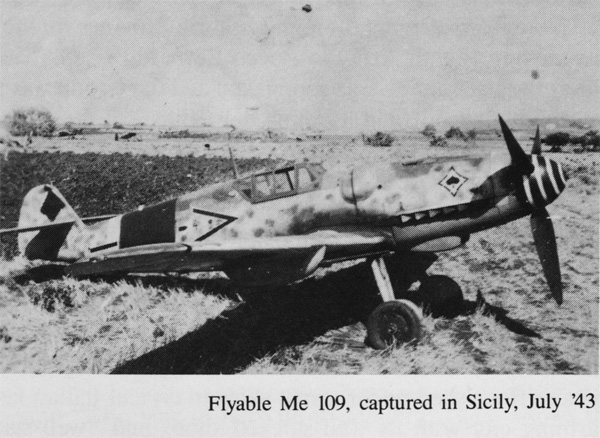
GERMAN ME-109’S
ACQUIRED:
A veteran of 114 fighter
plane combat missions Captain James Hadnot,
while on leave to the U.S., listed as
one of his most unique experiences his
flying of three captured German Me-109’s
taken on Sicily.
He said in a news interview,
“During the Sicilian campaign one
German airport was captured so quickly
the Germans didn’t have time to
destroy three of the Me-109’s on
the field. After these planes were painted
a bright yellow and given Army markings
for easy identification they were turned
over to the 57th for trial.” As
soon as he mastered the technique of flying
them – and according to Jimmy they
take special handling – he in turn
instructed other pilots in their use.
The planes were not modified in any way,
the instrument markings were left in German
and on occasions German gasoline was used
in them for more accurate competitive
performance.
Using the captured German
planes selected pilots flew them in combat
and simulated “dogfights”
with pilots in American planes so our
men would be familiar with the abilities
and weaknesses of the Me-109’s.
Before mid 1943, the African
Campaign was the “only game in town”
from the U.S. public’s point of
view. With that campaign over, the Pantelleria
operation finished and the Sicily action
drawing to a close, the public’s
attention was being drawn to England where
American forces had been building up.
The softening up of the enemy had begun
in preparation for D-Day, which was to
occur a year later. The Ninth Air Force
was being transferred to England with
much of the press corps following them.
The 12th Air Force, which had entered
Africa through Morroco on the west coast,
had supported the American ground forces
entering Africa, also from the west, near
the end of 1942, remained in the Mediterranean
to support the Italian campaign. On August
22, 1943, the 57th was transferred to
it.